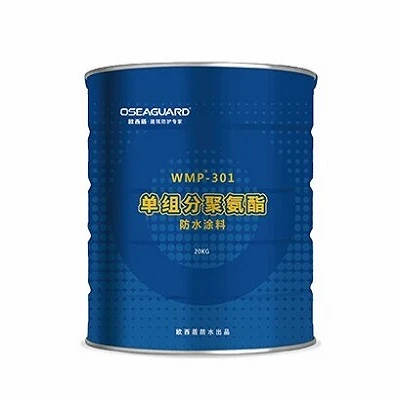

Polymer-modified cement-based waterproof slurry is a two-component hydraulic waterproofing system. It combines the high compressive strength of Portland cement with the flexibility and crack-bridging properties of redispersible polymer powders (RPP) or liquid acrylic polymers.
When mixed and applied to mineral substrates, active chemical components penetrate capillary pores to form insoluble crystal networks, while the polymer matrix builds a seamless, flexible, vapor-permeable waterproof membrane. Engineered for reinforced concrete and masonry structures subject to positive and negative hydrostatic pressure. Conforms to EN 1504-2 (System Principle 2.3 & 8.2) and carries the CE Mark.
Technical Specifications
|
Test Parameter |
Typical Value / Result |
Test Standard |
|
System Type |
Two-Component (Powder Component A : Liquid Component B = 3:1 by weight) |
ISO 3251 |
|
Mixing Ratio (P:L) |
3:1 (Standard Flexible Grade) / 4:1 (Rigid Grade) |
Factory Quality Spec |
|
Pot Life |
45 – 60 minutes (20°C) |
EN 196-3 |
|
Adhesion Strength (Bond Strength) |
>= 1.2 MPa (Concrete substrate cohesive failure) |
EN 1542 |
|
Impermeability (Negative Pressure) |
>= 0.8 MPa (No leakage for 30 mins) |
EN 12390-8 / GB/T 23445 |
|
Impermeability (Positive Pressure) |
>= 1.5 MPa (No leakage for 30 mins) |
EN 12390-8 / GB/T 23445 |
|
Crack-Bridging Ability |
>= 0.6 mm (Class A2 at 20°C) |
EN 1062-7 |
|
Water Vapor Permeability |
Class I (Sd < 5 m) |
EN ISO 7783 |
|
Application Temperature |
+5°C to +35°C (Substrate temperature) |
Site Condition |
|
Total Dry Film Thickness |
1.5 – 2.0 mm (Applied in 2 consecutive coats) |
Site Practice |
Key Features
Dual Protection Mechanism: Reactive crystallizing agents seal capillary micro-cracks (< 0.4 mm), while the cross-linked polymer film maintains elasticity under thermal cycling.
Negative Hydrostatic Pressure Resistance: Withstands back-pressure water infiltration up to 0.8 MPa, preventing dampness and peeling on interior basement walls.
High Breathability (Sd < 5 m): Allows trapped substrate moisture to escape as vapor, eliminating blistering and delamination caused by vapor pressure accumulation.
Strong Mineral Substrate Bond: Forms an integral bond with concrete, mortar, and brick masonry via calcium silicate hydrate (C-S-H) reaction zones.
Wet-on-Wet Application Compatibility: Can be applied directly onto damp, saturated surface dry (SSD) concrete substrates without priming.
Application Areas
Subterranean Structures: Basement retaining walls, foundation slabs, elevator pits, and underground utility tunnels.
Water Management Facilities: Potable water tanks (BS 6920 / WRAS compliant grades available), wastewater treatment basins, and secondary containment structures.
Wet Rooms & Podium Decks: Bathrooms, commercial kitchens, balconies, terraces, and swimming pool shells prior to ceramic tile installation.
Retaining Walls & Planters: Exterior earth-contact retaining walls to prevent rising damp and salt efflorescence.
Application Method
Substrate Preparation
Remove laitance, oil, grease, curing compounds, and loose particles via scarifying, abrasive blasting, or high-pressure water jetting (>= 150 bar).
Repair honeycombs, tie-rod holes, and bug holes using polymer repair mortar.
Pre-daturate the substrate with clean water to a Saturated Surface Dry (SSD) condition. Avoid standing pools of water.
Mixing
Pour the liquid component (Component B) into a clean mixing vessel.
Slowly add the powder component (Component A) under continuous mechanical agitation using a low-speed paddle mixer (400 - 500 rpm).
Mix for 3 to 5 minutes until a lump-free, homogeneous consistency is achieved. Allow the mixture to slake for 3 minutes, then re-stir briefly before application.
Application
First Coat: Apply the slurry uniformly using a stiff-bristled masonry brush, roller, or flat trowel at a thickness of approx. 1.0 mm. Work the material firmly into the substrate pores.
Reinforcement: Embed alkali-resistant fiberglass mesh into the wet first coat at internal corners, pipe penetrations, and high-stress joints.
Second Coat: Allow the first coat to cure to a touch-dry state (approx. 4 to 8 hours depending on ambient temperature). Apply the second coat in a perpendicular direction (90 degrees) to the first coat to ensure complete pinhole-free coverage. Total dry film thickness must reach 1.5 – 2.0 mm.
Curing & Protection
Protect freshly applied coatings from direct sunlight, strong wind, and frost for at least 24 hours.
Mist spray with clean water if drying occurs too rapidly in hot climates.
Allow 7 days of curing before filling water tanks or applying cement-based tile adhesives.
Product Selection Guide
|
Grade |
Polymer Ratio |
Flexibility |
Primary Application |
Recommended Substrates |
|
WS-300 (Rigid) |
Low (Powder-heavy) |
Non-flexible (< 0.1 mm) |
Basements, retaining walls, non-moving underground structures. |
Cast concrete, solid masonry. |
|
WS-500 (Flexible) |
Medium |
Moderate (>= 0.5 mm) |
Balconies, wet rooms, swimming pools, podium decks. |
Concrete screeds, precast panels. |
|
WS-800 (High-Flex) |
High (Acrylic-rich) |
High (>= 1.5 mm) |
Structures subject to thermal movement or minor vibration. |
Lightweight concrete, composite decks. |
OEM & ODM / Customization
Formulation Customization: Tailored setting times (fast-set options for low-temperature zones), variable polymer-to-cement ratios, and customized tensile elongation properties.
Packaging & Private Label: Kraft paper bags or plastic pails featuring your brand logo, barcode, multi-language instructions (EN/ES/FR/DE), and CE compliance labeling.
Batch Testing & Documentation: Third-party laboratory testing reports (SGS/TÜV) and CE certificates of constancy of performance provided per production batch upon request.
Manufacturing & Quality Control
Production Capacity: Automated dry-mix mortar production lines yielding 120,000 metric tons annually; liquid polymer synthesis reactors with 50,000 L daily output.
Raw Material Traceability: Ordinary Portland Cement (CEM I 52.5), graded quartz sand (silica purity >= 99%), and re-dispersible polymer powders sourced from ISO-certified tier-1 chemical suppliers.
In-House Quality Testing: Each production batch undergoes rigorous laboratory testing for fineness, bulk density, pot life, wet density, bond strength, and impermeability pressure before palletizing.
Quality Management System: Manufactured under ISO 9001 (Quality Management) and ISO 14001 (Environmental Management) standards; products comply with EN 1504-2 specifications.
Packaging & Storage
Component A (Powder): 25 kg multi-wall paper bags with moisture barrier PE lining; 40 bags per wooden pallet, shrink-wrapped and strapped.
Component B (Liquid): 10 kg / 20 kg plastic jerry cans or 1,000 kg IBC containers.
Shelf Life: 12 months for powder bags; 12 months for liquid drums when stored unopened in dry, shaded conditions between +5°C and +35°C. Protect from direct moisture and freezing.
FAQ
Q: Can this slurry be applied directly over existing ceramic tiles?
A: No. The substrate must be sound mineral concrete or render. Tiles and old coatings must be completely removed, and the bare substrate prepared mechanically.
Q: What is the minimum application temperature?
A: Application must not proceed if ambient or substrate temperature falls below +5°C, or if temperatures are expected to drop below 0°C within 24 hours of application.
Q: Is the cured membrane safe for potable water contact?
A: Yes. Fully cured WS-500 and WS-800 series formulations comply with drinking water contact standards (tested in accordance with BS 6920 / WRAS requirements; test certificates available upon request).
Q: What is your standard Minimum Order Quantity (MOQ) for OEM private labeling?
A: The standard MOQ for custom-printed packaging is 1 full 20-foot container load (FCL), approx. 20 to 24 metric tons. Mixed pallet trial orders are available for standard factory packaging.
Hot Tags: cement-based waterproof slurry, China cement-based waterproof slurry manufacturers, suppliers, factory, elastomeric roof waterproof coating, liquid waterproof coating, low voc waterproof coating, multi substrate waterproof coating system, substrate bonding waterproof coating, vapor barrier coating waterproof