
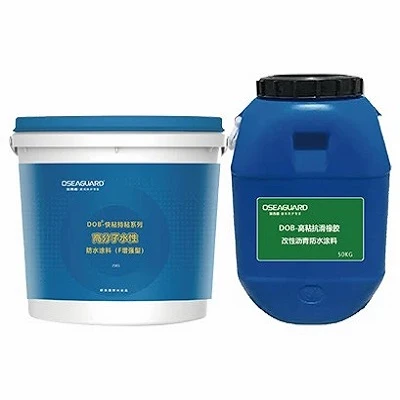
This two-component (Component A: Isocyanate prepolymer, Component B: Polyol/Curant blend) liquid polyurethane waterproofing membrane cures via a chemical cross-linking reaction upon mixing, forming a seamless, elastomeric, and monolithic waterproof barrier. Unlike single-component moisture-cured systems, the two-component formulation allows controlled reaction kinetics, rendering it suitable for thick-section application without solvent-entrapment or bubbling issues.
Designed for rigorous structural waterproofing, the system accommodates high dynamic substrate movement and bridges hairline cracks up to 2.5 mm under cyclic thermal stress. It adheres tenaciously to primed concrete, metal, and existing built-up roofing membranes when applied via squeegee, roller, or airless spray equipment.
Technical Specifications
|
Property |
Typical Value |
Test Standard |
|
Mixing Ratio (A by weight) |
1 : 3 to 1 : 5 (Customizable per project) |
Gravimetric Analysis |
|
Solids Content |
>= 95% |
ASTM D2697 / ISO 3251 |
|
VOC Content |
< 50 g/L (Solvent-free formulation) |
ASTM D3960 / ISO 11890-2 |
|
Tensile Strength |
>= 3.5 MPa |
ASTM D412 / ISO 37 |
|
Elongation at Break |
>= 600% |
ASTM D412 / ISO 37 |
|
Tear Strength |
>= 25 N/mm |
ASTM D624 |
|
Adhesion to Concrete |
>= 2.0 MPa (Concrete failure) |
ASTM D4541 / ISO 4624 |
|
Shore A Hardness |
65 - 80 |
ASTM D2240 |
|
Pot Life (25°C) |
30 - 45 minutes |
ISO 9514 |
|
Tack-Free Time |
<= 8 hours |
ASTM C836 |
|
Service Temperature Range |
-40°C to +90°C |
Dynamic Thermal Testing |
Key Features
High Elastic Recovery: Maintains elasticity and crack-bridging capability across sub-zero winter temperatures and high-heat summer conditions.
Low-VOC Environmental Compliance: Solvent-free formulation with VOC content < 50 g/L, complying with strict green building standards and indoor air quality regulations.
Chemical Resistance: Resists mild acids, alkalis, salt fog, and sewage immersion, preventing chemical degradation in industrial environments.
Seamless Monolithic Application: Eliminates lap joints and weak seams inherent in prefabricated sheet membranes, mitigating root causes of leak pathways.
Controlled Curing Dynamics: Decouples curing speed from ambient atmospheric moisture, ensuring predictable demolding or recoating intervals.
Application Areas
High Elastic Recovery: Maintains elasticity and crack-bridging capability across sub-zero winter temperatures and high-heat summer conditions.
Low-VOC Environmental Compliance: Solvent-free formulation with VOC content < 50 g/L, complying with strict green building standards and indoor air quality regulations.
Chemical Resistance: Resists mild acids, alkalis, salt fog, and sewage immersion, preventing chemical degradation in industrial environments.
Seamless Monolithic Application: Eliminates lap joints and weak seams inherent in prefabricated sheet membranes, mitigating root causes of leak pathways.
Controlled Curing Dynamics: Decouples curing speed from ambient atmospheric moisture, ensuring predictable demolding or recoating intervals.
Product Selection Guide
Selecting the correct grade depends on substrate geometry, application method, and environmental exposure:
Grade PU-2C-SP (Spray Grade): Viscosity optimized for plural-component heated airless spray equipment. Used for large-scale industrial roofs and bridge decks requiring rapid production rates (>= 1,000 m²/day).
Grade PU-2C-HV (Hand/Roller Grade): Thixotropic paste consistency preventing sag on vertical walls and parapets. Applied via notched trowel, brush, or heavy-duty roller.
Grade PU-2C-FR (Fire-Retardant Grade): Formulated to meet specific building codes requiring enhanced flame resistance for exposed commercial roof applications.
OEM & ODM / Customization
We operate under strict contract manufacturing protocols to match your regional market specifications and brand standards.
Rheology Adjustment: Viscosity tuning for brush, roller, squeegee, or plural-component spray application.
Curing Rate Modification: Fast-cure catalysts for low-temperature winter application (0°C - 10°C) or extended open time for tropical climates.
Color Matching: Standard RAL colors available (Slate Grey, Tile Red, White) to meet aesthetic or heat-reflection requirements.
Private Labeling: Custom pail printing, tamper-evident seals, multilingual Technical Data Sheets (TDS), and Safety Data Sheets (SDS) matching your corporate identity.
Manufacturing & Quality Control
Raw Material Verification: Incoming polymeric polyols and MDI/TDI prepolymers undergo strict Fourier-Transform Infrared Spectroscopy (FTIR) testing and hydroxyl/isocyanate value titration.
Automated Batch Processing: Enclosed, vacuum-sealed reactor vessels operate under dry nitrogen blankets to prevent premature moisture reaction and eliminate entrapped air.
Dispersion Control: High-shear Cowles dissolvers and bead mills ensure pigment and extender particle sizes are milled below 25 microns, preventing settlement and settling streaks.
In-Process Quality Audits: Every production batch is tested for viscosity (Brookfield viscometer), density, and non-volatile matter before packaging. Retention samples are stored for 24 months for traceability.
Packaging & Storage
Packaging Configurations:
Component A: Steel pails or drums (Net weight: 20 kg / 200 kg).
Component B: Steel pails or drums (Net weight: 10 kg / 100 kg).
Ratio-matched packaging prevents field proportioning errors.
Storage Conditions: Store in original, unopened containers in a dry, shaded area between 5°C and 30°C. Protect from direct sunlight and moisture ingress.
Shelf Life: 12 months from the date of manufacture.
FAQ
Q: What happens if the mixing ratio (A) is slightly off during site application?
A: Deviations exceeding +/- 5% from the specified weight ratio will impair cross-linking density. An excess of Component A leads to brittle films susceptible to environmental stress cracking; an excess of Component B results in permanently soft, tacky, and under-cured membranes with reduced tensile strength. Gravimetric or calibrated mechanical mixing equipment is strictly recommended.
Q: Can this coating be applied directly to green concrete?
A: Substrate moisture content must not exceed 4% (tested via electronic moisture meter). For concrete cured less than 28 days or with higher moisture levels, a specialized moisture-tolerant epoxy primer must be applied first to prevent osmotic blistering and adhesive failure.
Q: Is a topcoat required for UV exposure?
A: Standard aromatic polyurethane coatings will experience chalking and color fading under prolonged direct sunlight without mechanical degradation of structural performance. For applications requiring aesthetic color retention, apply an aliphatic polyurethane topcoat within 24 to 48 hours of basecoat curing.
Q: What is the minimum application temperature?
A: Application is restricted to substrate temperatures between 5°C and 35°C, with the substrate temperature at least 3°C above the local dew point to prevent condensation on the surface during the curing phase.
Hot Tags: two-component liquid polyurethane waterproof coating, China two-component liquid polyurethane waterproof coating manufacturers, suppliers, factory, brick waterproof coating, cementitious waterproofing slurry coating, epoxy waterproof coating, roof sealing waterproof coating, seam sealing waterproof coating, structural waterproof coating


