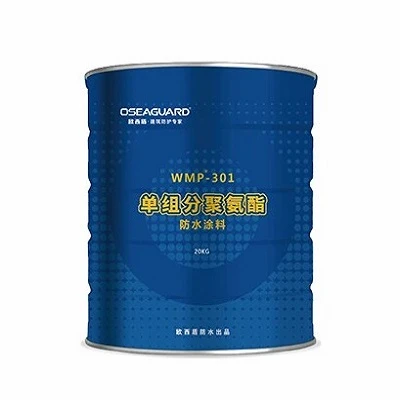

Polymer-Cement Crack-Resistant Waterproof Coating is a two-component reactive waterproofing system engineered for heavy-duty civil and commercial infrastructure. Part A is a synthetic polymer emulsion modified with specialized functional additives; Part B is a pre-blended inorganic powder consisting of ordinary Portland cement (ASTM C150 / EN 197-1 compliant), active mineral fillers, and graded quartz aggregates.
Mixed on-site, the components cross-link to form a dense, seamless elastomeric membrane. The cured matrix combines the compressive strength and durability of inorganic cement with the elasticity and crack-bridging performance of organic polymers, accommodating dynamic structural substrate movement up to 1.5 mm without fracturing. Certified under ISO 9001 quality management systems and aligned with ASTM C836 / EN 14891 performance frameworks.
Technical Specifications
|
Test Parameter |
Typical Value |
Testing Standard |
|
System Type |
Two-Component (Liquid Part A : Powder Part B) |
- |
|
Standard Mixing Ratio |
1 : 1.2 by weight (Adjustable for roller/spray) |
ISO 13007-1 |
|
Solid Content (Liquid Part A) |
>= 50% |
ISO 3251 |
|
Tensile Strength |
>= 1.8 MPa |
ASTM D412 / EN 12390-8 |
|
Elongation at Break |
>= 120% |
ASTM D412 |
|
Adhesion Strength (to Concrete) |
>= 1.2 MPa |
EN 1542 |
|
Impermeability (0.3 MPa, 30 min) |
No water penetration |
ASTM C1306 / GB/T 23445 |
|
Crack-Bridging Ability |
>= 1.5 mm (at 20 deg C) |
EN 1062-7 |
|
Pot Life |
45 - 60 minutes (at 25 deg C) |
- |
|
Curing Time (Touch Dry / Full Cure) |
4 hours / 7 days |
- |
Key Features
Dynamic Crack Bridging: Accommodates thermal expansion, contraction, and minor structural settling up to 1.5 mm, preventing reflective cracking through subsequent tile or screed finishes.
Dual-Directional Impermeability: Withstands both positive hydrostatic pressure (roof decks, water features) and negative hydrostatic pressure (basement retaining walls, elevator pits).
High Substrate Affinity: Forms a monolithic chemical and mechanical bond with damp concrete, masonry, cement mortar, and screed surfaces without requiring a separate liquid primer.
Vapor Permeable Matrix: Permits trapped moisture vapor within the concrete substrate to escape safely, eliminating blistering and delamination risks.
Eco-Friendly Formulation: Water-based system containing zero volatile organic compounds (VOCs); non-toxic and safe for contact with potable water storage structures after complete 28-day curing.
Application Areas
Water Retaining Structures: Swimming pools, landscape ponds, water treatment tanks, and irrigation channels.
Roofing & Balconies: Exposed concrete flat roofs, podium decks, balconies, and terraces underneath ceramic tile or protective mortar beds.
Subterranean Structures: Foundation walls, basement retaining walls, elevator pits, and underground parking garages (applied on positive or negative sides).
Wet Areas: Commercial bathrooms, industrial kitchens, laundry rooms, and high-traffic shower enclosures prior to tiling.
Product Selection Guide
|
Grade Designation |
Recommended Application |
Primary Performance Focus |
|
PC-C100 (Standard) |
Indoor wet rooms, residential bathrooms, kitchens |
Cost-effective, high early bond strength, rapid tiling turnaround. |
|
PC-C200 (Flexible) |
Roof decks, balconies, exterior walls, dynamic joints |
High elongation (> 150%), superior thermal shock resistance. |
|
PC-C300 (Heavy-Duty) |
Basements, swimming pools, underground civil works |
High hydrostatic pressure resistance (> 0.4 MPa), immersion durability. |
OEM & ODM / Customization
We support complete private labeling and formulation adaptations tailored to your regional market standards:
Formulation Engineering: Tailor solid content, elongation rates, viscosity, and setting time based on local temperature profiles and application methods (brush, roller, or airless spray).
Packaging Customization: Full OEM printing on plastic barrels (Part A) and moisture-resistant multi-layer kraft paper bags (Part B) featuring your corporate branding, SKU data, barcodes, and local regulatory text.
Regulatory & Documentation Support: Comprehensive provision of formulation safety sheets, raw material technical datasheets, and third-party laboratory test reports (e.g., SGS, Intertek equivalents) to accelerate local market clearance.
Manufacturing & Quality Control
Automated Batching Towers: Computer-controlled powder dry-blend mixing towers ensure precise aggregate grading and homogeneous additive distribution within a tight +/- 0.5% tolerance.
Emulsion Polymerization Control: Precision-regulated reactor temperatures and monomer feed rates during Part A production guarantee stable polymer particle size and dependable shelf life during shipping.
In-House Laboratory Testing: Every production lot undergoes mandatory batch testing for solid content, viscosity, tensile strength, and pot life prior to release. Retained reference samples are archived for 24 months for complete batch traceability.
System Certifications: Produced in an ISO 9001 and ISO 14001 certified manufacturing facility.
Packaging & Storage
Standard Packaging:
Component A (Liquid): 10 kg or 20 kg heavy-duty plastic drums.
Component B (Powder): 12 kg or 25 kg multi-layer kraft paper bags with PE inner liner.
Combi-pails available upon request for retail distribution networks.
Storage Conditions: Store in original, unopened packaging in dry, shaded warehouses between 5 deg C and 35 deg C. Protect from direct sunlight and freezing temperatures.
Shelf Life: 12 months from the date of manufacture under recommended storage conditions.
FAQ
Q: Can this coating be applied directly to damp concrete substrates?
A: Yes. The substrate must be in a saturated surface dry (SSD) condition with no standing or pooling water. The cementitious matrix cures via hydration, allowing strong adhesion to damp mineral surfaces.
Q: Can ceramic tiles be installed directly on top of the cured membrane?
A: Yes. The rough, textured profile of the cured cementitious coating provides an exceptional mechanical key for cement-based tile adhesives (C1/C2 grade). Allow a minimum of 48–72 hours curing before tile installation.
Q: What is the minimum required total dry film thickness (DFT)?
A: For standard waterproofing, a minimum total DFT of 1.5 mm is recommended, applied in at least two cross-directional coats. For high-hydrostatic pressure areas (e.g., swimming pools), apply 2.0 mm minimum.
Q: Do you provide free product samples for laboratory testing?
A: Yes. We supply complimentary sample kits (combined liquid and powder) for distributor technical evaluation and lab testing. Freight collect or courier account required.
Hot Tags: polymer-cement crack-resistant waterproof coating, China polymer-cement crack-resistant waterproof coating manufacturers, suppliers, factory, acid resistant waterproof coating, Polymer Waterproof Coating, polyurethane waterproof coating, roof sealing waterproof coating, tunnel waterproof coating system, water repellent coating system