

Product Overview
A two-component, heavy-duty cementitious waterproofing membrane engineered for structural waterproofing and damp-proofing. Component A consists of an acrylic-modified polymer dispersion; Component B is a factory-blended powder containing graded quartz aggregates, Portland cement, and active chemical catalysts.
Mixed on-site, the material forms a thixotropic slurry that applies smoothly by brush, roller, or airless spray. Upon curing, it creates a seamless, vapor-permeable elastomeric barrier capable of accommodating dynamic substrate micro-movements up to 0.75 mm. Engineered to withstand active structural hydrostatic pressure from both positive and negative directions.
-
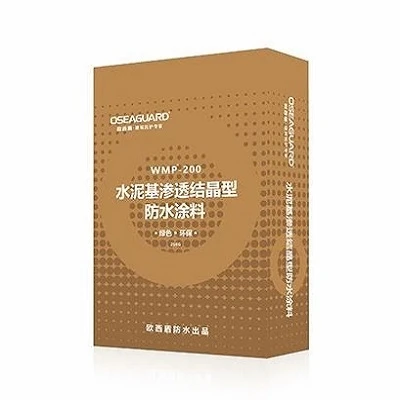
![Polymer-Cement Crack-Resistant Waterproof Coating]() Polymer-Cement Crack-Resistant Waterproof CoatingMixed on-site, the components cross-link to form a dense, seamless elastomeric membrane. The cured matrix combines the compressive strength and durability of inorganic cement with the elasticity andread more
-
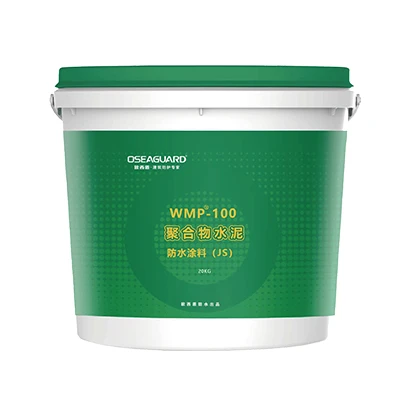
![Polymer-Cement Waterproof Slurry]() Polymer-Cement Waterproof SlurryPolymer-Cement Waterproof Slurry (often classified as JS Waterproofing Coating in international trade) is a dual-component elastomeric cementitious membrane formulated for concrete protection andread more
-
![Acrylic-Modified Polymer-Cement Waterproof Coating]() Acrylic-Modified Polymer-Cement Waterproof CoatingThis product is a two-component, elastomeric waterproofing membrane comprising a synthetic acrylic polymer emulsion (Component A) and a specially graded cementitious powder blend containing activeread more
-
![Two-Component Polymer-Cement Waterproof Coating]() Two-Component Polymer-Cement Waterproof CoatingOur Two-Component Polymer-Cement Waterproof Coating (JS Coating) is a reaction-cured, elastomeric membrane formulated by combining a high-performance acrylic copolymer emulsion (Component A) with aread more
-
![Flexible Polymer-Cement Waterproof Coating]() Flexible Polymer-Cement Waterproof CoatingFlexible Polymer-Cement Waterproof Coating is a dual-component elastomeric membrane formulated from a specialized liquid acrylic polymer dispersion and a cementitious powder blend containing gradedread more
-
![Polymer-Cement JS Waterproof Coating]() Polymer-Cement JS Waterproof CoatingPolymer-Cement JS Waterproof Coating is a dual-component reactive waterproofing system. It combines an acrylic-copolymer liquid emulsion with a specialized Portland cement-graded mineral powderread more


Dual-Directional Pressure Tolerance:
Withstands active water pressure from both positive (water contact side) and negative (seepage side) faces, preventing blistering and delamination.
Dynamic Crack Accommodation:
High polymer-to-cement ratio maintains membrane elasticity across seasonal thermal cycles, preventing structural tear at hairline cracks.
Matrix Compatibility:
Ordinary Portland cement-based powder matrix ensures complete physical and chemical affinity with concrete, masonry, and cement screeds.
Vapor Permeability:
Micro-porous matrix structure allows entrapped structural moisture vapor to escape safely, eliminating internal vapor-pressure blistering.
Potable Water Certified:
Formulated without coal tar, heavy metals, or toxic solvents; safe for use in drinking water reservoirs and aquaculture basins.
Technical Specifications
|
Test Parameter |
Typical Value |
Compliance Standard |
|
Mixing Ratio (Liquid : Powder) |
1 : 3 by weight (Adjustable for spray/brush) |
Internal QC / ISO 3221 |
|
Pot Life (20°C / 68°F) |
45 - 60 minutes |
EN 196-3 / ASTM C191 |
|
Adhesion Strength to Concrete |
>= 1.5 MPa (217 psi) |
EN 1542 / ASTM D4541 |
|
Tensile Strength |
>= 1.8 MPa (261 psi) |
ASTM D412 |
|
Elongation at Break |
>= 120% |
ASTM D412 |
|
Crack Bridging Ability |
>= 0.75 mm (Class A2 / B2) |
EN 1062-7 |
|
Hydrostatic Pressure Resistance |
Positive: 0.7 MPa (7 bar) Negative: 0.3 MPa (3 bar) |
DIN 1048-5 / ASTM D5385 |
|
VOC Content |
< 15 g/L (Low VOC / Eco-compliant) |
ISO 11890-2 / SCAQMD Rule 1113 |
Application Areas
Below-Grade Structures:
Basement retaining walls, foundation slabs, elevator pits, and tunnel linings.
Horizontal Podium Decks:
Plaza decks, external balconies, roof terraces, and parking garages prior to wearing-course installation.
Wet Environments:
Commercial kitchens, institutional washrooms, industrial processing plants, and shower blocks.
Water Retaining Assets:
Potable water tanks, swimming pools, wastewater treatment clarifiers, and irrigation channels.
Suitable Substrates
Cast-in-Place Concrete:
Minimum compressive strength 25 MPa (3600 psi), fully cured for at least 28 days.
Cementitious Renders & Screeds:
Densified, mechanically finished surfaces free of loose particles.
Concrete Masonry Units (CMU):
Fully mortared joints with flush-struck, stable surfaces.
(Incompatible with gypsum boards, timber, metal sheets, and old bitumen membranes without specialized mechanical priming).
Application Method
Mechanically scarify, shot-blast, or grind concrete to remove curing compounds, form-release agents, oil, and weak surface laitance (achieve a Concrete Surface Profile CSP 3 to CSP 4).
Repair honeycombs, tie-rod holes, and structural voids using shrinkage-compensated polymer repair mortar.
Pre-dampen the substrate to a saturated surface-dry (SSD) condition; remove all standing water puddles.
Pour Component A (liquid polymer) into a clean mixing vessel.
Gradually add Component B (powder) under continuous agitation using a low-speed industrial mixer (400 - 500 RPM) for 3 - 5 minutes until a uniform, lump-free slurry is achieved.
Allow the mix to slake for 3 minutes, then re-stir briefly. Do not add unauthorized extra water.
First Coat: Apply uniformly using a stiff masonry brush, roller, or airless spray unit at a wet film thickness of approx. 1.0 - 1.2 mm. Embed alkali-resistant fiberglass reinforcing mesh into critical internal corners and joints while wet.
Recoating Window: Allow the first coat to cure for 4 - 8 hours depending on site temperature until firm to the touch.
Second Coat: Apply the second coat perpendicular (90°) to the first coat direction to ensure pinhole-free full coverage. Total dry film thickness must equal 1.5 - 2.0 mm.
Protect freshly laid membranes from direct high winds, direct hot sun, and freezing temperatures for at least 24 hours.
Flood testing for water containment structures must only be conducted after 7 days of complete curing at +20°C.
Standard Export Packaging
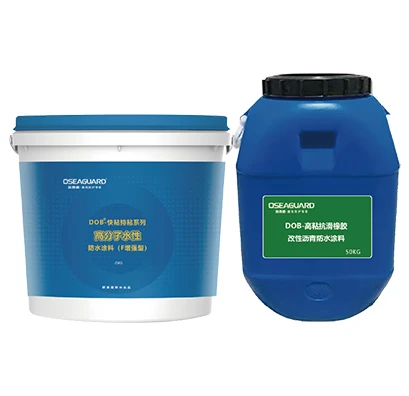
Combo Set: 32 kg total (20 kg moisture-resistant PE-lined woven bag for Powder + 12 kg sealed plastic pail for Liquid).
Bulk Industrial Pack: 200 kg liquid drum + 25 kg powder bags.
Shelf Life
Powder: 12 months in original unopened packaging stored in dry conditions.
Liquid: 12 months, protect from freezing and direct solar radiation.
Storage Requirements
Store indoors on wooden pallets off ground contact. Maintain ambient storage temperatures between +5°C and +35°C (41°F - 95°F).
We provide industrial contract manufacturing and custom formulation development for global building chemical brands:
Private Label Packaging: Custom-printed plastic pails and moisture-proof bags featuring your brand identity, bilingual manuals, and regional barcode systems.
B Viscosity and open-time adjustments customized for extreme climatic conditions (e.g., high-temperature tropical sites or low-temperature autumn projects).
Polymer-to-Cement Ratio Adjustment: Solids content modifications tailored to meet specific regional tender specifications (Standard Commercial vs. Heavy-Duty Civil Engineering tiers).

Manufacturing & Quality Control
Automated Gravimetric Batching: Computer-controlled dosing silos ensure precise proportioning of raw cementitious inputs and graded aggregates, eliminating human weighing errors.
Controlled Emulsion Synthesis: Liquid polymer production utilizes jacketed reactor vessels with temperature feedback loops to maintain consistent co-polymer dispersion stability.
Rigorous Factory: QEvery production run undergoes raw material verification, wet-state viscosity checks, mortar flow tests, and 28-day tensile/bond strength validation in our certified internal testing laboratory prior to release.
Facility Certifications: Manufactured under ISO 9001 Quality Management and ISO 14001 Environmental Management operational guidelines.
FAQ
Q: Can this waterproofing system be applied directly onto green (newly cast) concrete?
A: Yes, provided the concrete has attained sufficient structural integrity (minimum 7-14 days old) and surface bleed water has completely evaporated. The required SSD (saturated surface-dry) substrate condition actually assists the cement hydration process.
Q: What are the lower temperature limits for site application?
A: Application must not proceed if ambient or substrate temperature drops below +5°C (41°F) or is expected to fall below +5°C within 24 hours post-application. Never apply on frozen or frosting substrates.
Q: Can ceramic or stone tiles be installed directly over the cured membrane?
A: Yes. Polymer-modified cement tile adhesives (ISO 13007 / ANSI A118.4 compliant C2TE grade) can be applied directly onto the dried membrane after 3-7 days of ambient curing, provided the surface is clean, dust-free, and dry.
Q: What is the Minimum Order Quantity (MOQ) for custom private labeling?
A: Standard MOQ for custom-printed pails and bags begins at 1 x 20'GP container to maintain freight efficiency. Cross-product container consolidation with other cementitious materials is fully supported.
As one of the most professional polymer-cement waterproofing systems manufacturers and suppliers in China, we're featured by quality products and good service. Please rest assured to wholesale bulk customized polymer-cement waterproofing systems from our factory. Contact us for more details.
basement waterproofing coating system, chemical resistant waterproof coating, concrete bonding waterproof coating